
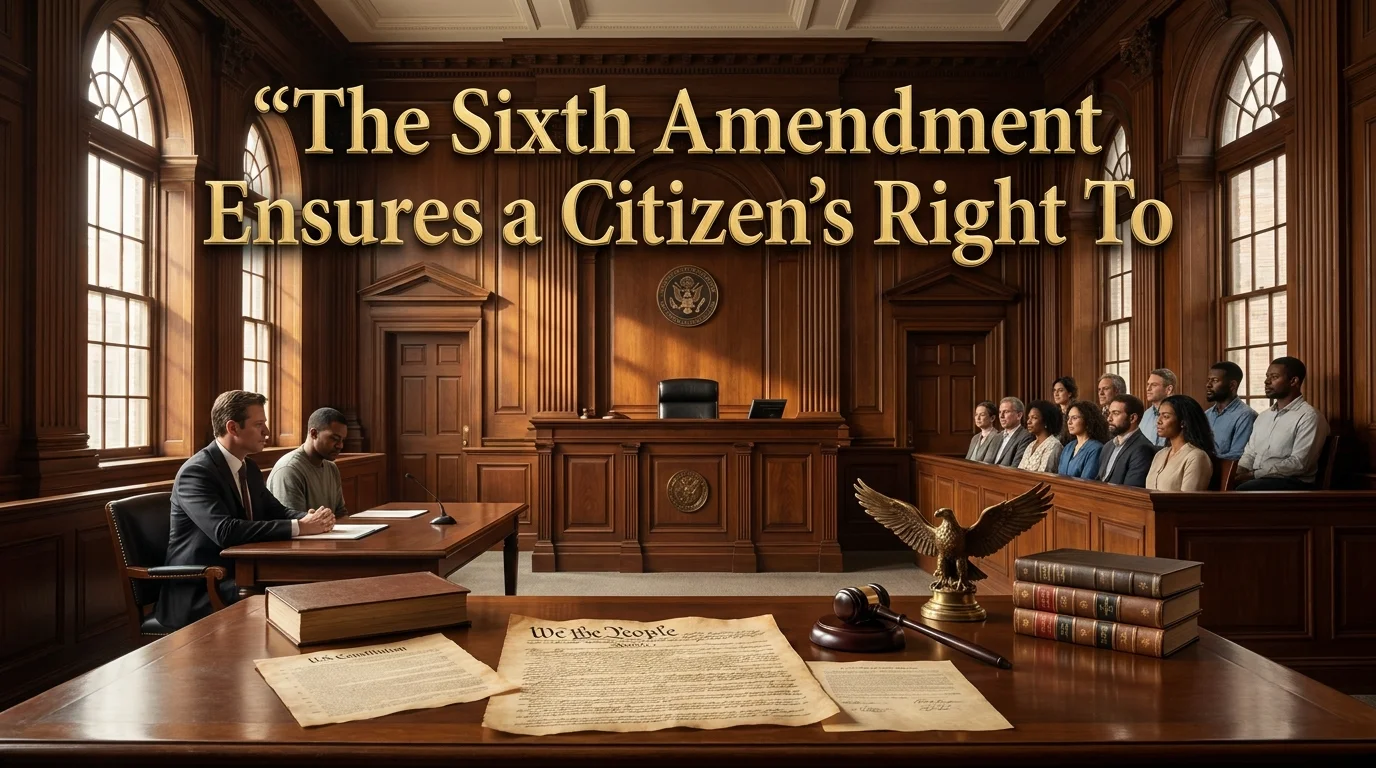
If you’re answering the question “the sixth amendment ensures a citizen’s right to ___,” the correct choice is have a fair trial. The amendment protects people accused of crimes through several specific trial rights.
Direct answer: The Sixth Amendment protects an accused person’s right to a fair criminal trial. Its guarantees include a speedy and public trial, an impartial jury, notice of the charges, confrontation of opposing witnesses, compulsory process for defense witnesses, and assistance of legal counsel.
Key facts at a glance
| Question | Answer |
|---|---|
| Correct quiz answer | Have a fair trial |
| Who receives the protections? | A person accused in a criminal prosecution |
| Speedy trial? | Yes |
| Public trial? | Yes |
| Impartial jury? | Protected in qualifying criminal cases |
| Notice of charges? | Yes |
| Witness rights? | The accused may confront opposing witnesses and seek favorable witnesses |
| Right to a lawyer? | Yes, subject to rules about when appointed counsel is required |
For more plain-language legal information, readers can browse Clipaper’s Law section.
Key takeaways
- “Have a fair trial” is the correct answer to the common multiple-choice question.
- The constitutional text protects several individual rights that work together to promote a fair criminal process.
- These include speedy and public proceedings, an impartial jury, notice of the charges, witness rights, and legal counsel.
- The wording of the Constitution refers to “the accused” rather than limiting the protection to “citizens.”
- Other choices, such as freedom of worship or the right to bear arms, come from different constitutional amendments.
Why the Sixth Amendment ensures a citizen’s right to a fair trial
The phrase “right to a fair trial” is a useful summary rather than the amendment’s exact wording. The constitutional text lists several safeguards for someone facing a criminal prosecution. Together, they help protect defendants from one-sided or unfair criminal proceedings.
That distinction matters for students. A test may ask for a single broad answer, whereas the Constitution provides several specific protections.
If the options are worship freely, vote, have a fair trial, or bear arms, then “have a fair trial” is the intended answer. Freedom of religion is associated with the First Amendment. The Second Amendment addresses the right to keep and bear arms. Several later constitutional amendments protect voting rights.
The six major protections behind the answer
1. A speedy trial
An accused person has the right to a trial without unconstitutional delay. This protection helps prevent criminal cases from remaining unresolved indefinitely.
The Constitution does not establish one universal number of days for every case. Courts consider the circumstances when deciding whether a delay violated this right. Federal and state laws can provide additional timing rules.
2. A public trial
Criminal defendants also have the right to public proceedings. Open trials allow public scrutiny of the justice system and help guard against secret criminal proceedings.
The right is strong but not absolute. Courts may restrict access in limited circumstances when another overriding interest requires it.
3. An impartial jury
The amendment protects the right to an impartial jury in criminal cases where the jury-trial guarantee applies. Jurors should decide a case based on the evidence rather than personal bias.
The Supreme Court has interpreted impartiality to require that jurors evaluate a case fairly based on the evidence presented.
4. Notice of the charges
A person cannot fairly defend against a criminal accusation without knowing what the government alleges.
The Constitution therefore requires the accused to be informed of the nature and cause of the accusation. Constitution Annotated describes this protection as requiring adequate notice of the charges.
This protection becomes especially relevant once a case reaches court. Clipaper’s guide to preparing for court after bail discusses practical steps such as reviewing case documents and staying in contact with counsel.
5. The right to deal with witnesses
The accused has the right to confront witnesses who testify against them. This protection supports the ability to challenge testimony through the court process.
The accused can also use compulsory process to obtain witnesses who may provide favorable evidence. In simple terms, the defense has legal tools to bring relevant witnesses before the court.
6. Assistance of counsel
The right to legal counsel is another central protection. A criminal defendant may have an attorney assist in mounting a defense and participate in the adversarial court process.
The Supreme Court’s 1963 decision in Gideon v. Wainwright, recorded in the Constitution Annotated, held that the right to counsel applies to felony defendants in state courts through the Fourteenth Amendment. Courts must appoint counsel for defendants who cannot afford an attorney when constitutional rules require one.
When do these protections apply?
The Sixth Amendment begins with the words “In all criminal prosecutions.” That language is important. These protections concern the criminal justice process rather than creating the same set of rights for every civil dispute.
The timing and scope of individual rights can differ. For example, rules governing counsel, jury trials, public proceedings, and pretrial stages have developed through Supreme Court decisions.
Someone involved in an active criminal case should rely on the court, official government information, and qualified legal counsel for case-specific guidance. General educational explanations cannot determine how a constitutional rule applies to a particular set of facts.
Clipaper also explains related court procedures in its article on bench warrants and missed court appearances.
How the Sixth Amendment differs from other rights
The common quiz question becomes easier when you connect each answer choice to the correct constitutional protection.
| Possible answer | Constitutional connection | Correct here? |
| Worship freely | First Amendment religious protections | No |
| Vote | Voting rights are protected through several constitutional provisions and amendments | No |
| Have a fair trial | Criminal-trial protections summarized by the Sixth Amendment | Yes |
| Bear arms | Second Amendment | No |
This comparison is also a useful study method. Rather than memorizing one sentence, connect each amendment to the subject it addresses.
Students reviewing other criminal law topics can also read Clipaper’s plain-language definition and example of extortion.
The answer to remember
For a test or homework question, keep the answer simple: the correct choice is “have a fair trial.”
The deeper lesson is that fair criminal proceedings depend on several connected rights. Speed, openness, an unbiased decision-maker, notice of the charges, witness protections, and legal representation each gives the accused a meaningful chance to defend against a criminal charge. For related educational legal content, continue with Clipaper’s Law resources.
Frequently asked questions
It protects the accused’s right to assistance of counsel. Supreme Court decisions have also established when courts must provide an attorney to defendants who cannot afford one. Gideon v. Wainwright is a major case involving that protection.
The correct multiple-choice answer is a fair trial. More precisely, the amendment provides several protections for people accused in criminal prosecutions, including speedy and public proceedings, an impartial jury, notice of the charges, witness rights, and counsel.
The answer to remember
No. Trial protections and punishment protections come from different amendments. The Eighth Amendment addresses excessive bail, excessive fines, and cruel and unusual punishments.