
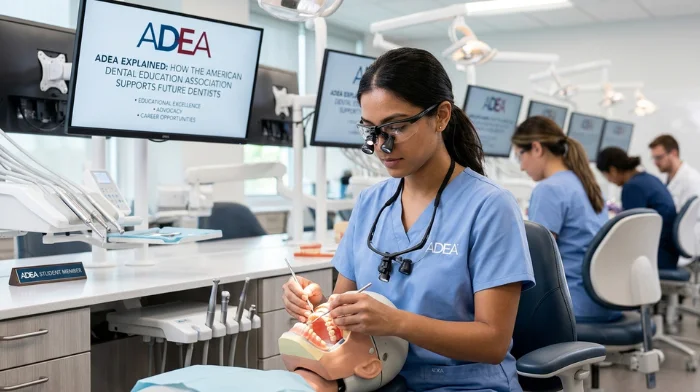
If you searched ADEA in the United States, you probably want the American Dental Education Association. The organization connects dental schools, applicants, students, educators, residents, and oral health programs. It also runs major centralized application services used across dental education.
The American Dental Education Association supports dental education across the United States and Canada. It serves applicants, students, faculty, programs, and institutions. Its services include centralized applications, professional development, research, advocacy, scholarships, leadership opportunities, and member resources. It is also a direct gateway to current application and contact information.
| Quick fact | Details |
|---|---|
| Full name | American Dental Education Association |
| Main purpose | Support academic oral health education, applicants, students, educators, and institutions |
| Current reach | 89 U.S. and Canadian dental schools and 800+ allied or advanced programs |
| Application services | AADSAS, CAAPID, DHCAS, and PASS |
| Current AADSAS cycle | May 12, 2026, through February 5, 2027 |
| Headquarters | 555 12th St NW, Suite 450, Washington, DC 20004 |
| Main phone | (202) 289-7201 |
| Official site | adea.org |
Key Takeaways
- The organization represents a large part of U.S. and Canadian academic oral health education.
- Four centralized services support different dental and allied dental application paths.
- Most U.S. dental schools use AADSAS for D.D.S. and D.M.D. applications.
- Individual schools still control prerequisites, interviews, deadlines, and admissions decisions.
- Students at member institutions may qualify for complimentary individual membership.
- Applicants should use official pages for current dates, fees, and service contacts.
What Does ADEA Mean for Dental Applicants?
The association describes itself as the national voice for academic oral health education. Its current community represents more than 65,000 people across the field. Members include all 89 U.S. and Canadian dental schools, plus over 800 allied and advanced programs.
That reach matters because dental education involves more than traditional dental schools. It also includes hygiene, assisting, therapy, laboratory technology, residency, and advanced training. The organization helps these groups share data, develop leaders, and coordinate education priorities.
Its work also extends beyond the application process. Members can access research, professional development, events, advocacy information, and educational publications. Students can find scholarships, leadership opportunities, webinars, and career resources through dedicated member programs.
Four Application Services and Who Uses Them
For many U.S. readers, the most practical service is centralized applications. The organization operates four systems for different education paths. Each system serves a distinct applicant group, so choosing the right one matters.
| Service | Main audience | Typical purpose |
|---|---|---|
| AADSAS | Prospective D.D.S. or D.M.D. students | Apply to participating dental schools |
| CAAPID | Internationally educated dentists | Apply to advanced standing programs |
| DHCAS | Dental hygiene applicants | Apply to participating dental hygiene programs |
| PASS | Dentists seeking advanced education | Apply to participating postgraduate programs |
Most U.S. dental schools use AADSAS for D.D.S. or D.M.D. applications. The current 2026–27 cycle runs from May 12, 2026, through February 5, 2027. Texas residents applying to Texas dental schools generally use TMDSAS instead.
Centralized processing does not mean centralized admissions decisions. AADSAS collects, verifies, and delivers application information to selected schools. Each dental school sets its own requirements, deadlines, interview process, and admission decisions. Applicants should also expect school-specific requirements after the main application. Some programs request supplemental applications, additional information, or separate fees. Checking every chosen school’s instructions can prevent missed requirements and late submissions.
Why the Association Matters Before Dental School
A single application platform can reduce repeated data entry across participating schools. Applicants still need to check every program’s prerequisites and supplemental requirements. Early preparation helps because evaluations, transcripts, experiences, and school choices can take time. Applicants should also consider school fit instead of relying only on rankings. Location, curriculum, clinical exposure, research opportunities, and community focus can differ widely. The official school listings can help applicants compare programs before making final designations.
Students can strengthen their general academic habits alongside application preparation. Clipaper’s student app guide covers tools for studying, writing, organization, and coursework. Those habits can become useful when college schedules grow more demanding.
Research literacy can also help students understand evidence and academic publications. Clipaper’s multiple-method research guide introduces ways researchers can combine methods and data sources. That background can help students approach scientific material with more structure. Wellness also matters during demanding academic programs. Clipaper’s emotional health guide discusses practical ways to notice and manage emotional strain. That topic complements professional resources focused on academic performance and career development.
Membership Benefits for Students and Educators
Membership benefits vary according to institutional affiliation. Students, residents, and fellows at member institutions can receive complimentary individual membership. Students outside member institutions currently pay $40 for individual membership.
Faculty and staff at member institutions can also access membership without individual dues. Member benefits include learning resources, communities, scholarships, awards, events, and professional publications. These benefits are especially relevant for people planning careers connected with academic dentistry. Practicing dentists and other professionals can qualify for individual membership under separate categories. Current faculty or staff outside covered institutions are listed at $125 annually. Retired dental and allied dental professionals are listed at $62.50.
Current Application Details for 2026–27

Applicants should pay close attention to date-sensitive information. As of September 2026, the 2026–27 AADSAS cycle remains open until February 5, 2027. Individual dental-school deadlines can still occur earlier than the centralized closing date.
The fee assistance window for this application cycle has already closed. Approved applicants received waivers covering three participating dental-school applications. The association listed that assistance as a $494 value for the 2026–27 cycle. The next fee assistance program is scheduled to reopen in April 2027. That program will support the 2027–28 application cycle. Applicants needing financial assistance should check official guidance before paying application fees.
Official Contact Information
If your goal is to reach the organization, use its official website instead of third-party directories. Its headquarters are at 555 12th Street NW, Suite 450, Washington, DC 20004. The main telephone number is 202-289-7201.
Application support teams are available Monday through Friday, 9 a.m. to 5 p.m. Eastern Time. Separate support contacts exist for AADSAS, CAAPID, PASS, and DHCAS. Start with the association’s official contact page for current service details. Membership questions use a separate membership contact. Application questions should go to the support team for the relevant service. Using the correct channel can reduce unnecessary transfers and help you reach specialized staff.
Don’t Confuse the Dental Association With Federal Employment Law
The same four letters can also refer to a federal employment law. The Age Discrimination in Employment Act became law in 1967. The U.S. Equal Employment Opportunity Commission states that this act protects workers who are age 40 or older.
Under 29 U.S.C. 630, published by Cornell Law School’s Legal Information Institute, the statute generally applies to employers with at least 20 employees. It covers areas such as hiring, compensation, promotion, discharge, and other employment terms. That meaning is separate from the dental-education organization discussed here. Context usually reveals which meaning a searcher needs. Dental-school searches usually concern the education association and its application systems. Workplace discrimination searches usually concern the federal age-discrimination statute.
What Applicants Should Do Next
Use official association pages to confirm deadlines before submitting any application. Then compare each school’s prerequisites, supplemental materials, and interview requirements. Save every deadline in one calendar so important tasks do not depend on memory.
Applicants should also prepare supporting materials before their preferred submission date. Recommendation letters can require coordination with professors, committees, or other evaluators. Earlier preparation gives you more time to correct missing information before deadlines arrive.
Your centralized application is only one part of the admissions process. School selection, academic preparation, interviews, supplemental materials, and individual deadlines still require separate attention. Treat the official application system as a shared starting point rather than the entire admissions strategy.
FAQ About ADEA
What does the acronym stand for in dental education?
Here, it stands for the American Dental Education Association. The organization focuses on dental and oral health education in the United States and Canada. It also operates centralized application services for several education paths.
Is the association the same as AADSAS?
No, the association is the broader professional organization. AADSAS is one of the centralized application services it operates. That service primarily supports applicants to participating D.D.S. and D.M.D. programs.
Do most U.S. dental schools use AADSAS?
Yes, most U.S. dental schools participate in the centralized service. Applicants should still verify every school’s instructions before submitting. Texas residents may need TMDSAS when applying to dental schools in Texas.
Does the centralized service decide who gets admitted?
No, the service processes and sends application information to the schools you select. Each school decides whom to interview, accept, waitlist, or deny. School-specific requirements and timelines can also differ.
Is student membership free?
It can be, depending on the student’s institution. Students, residents, and fellows at member institutions qualify for complimentary individual membership. Students outside member institutions currently pay $40.