
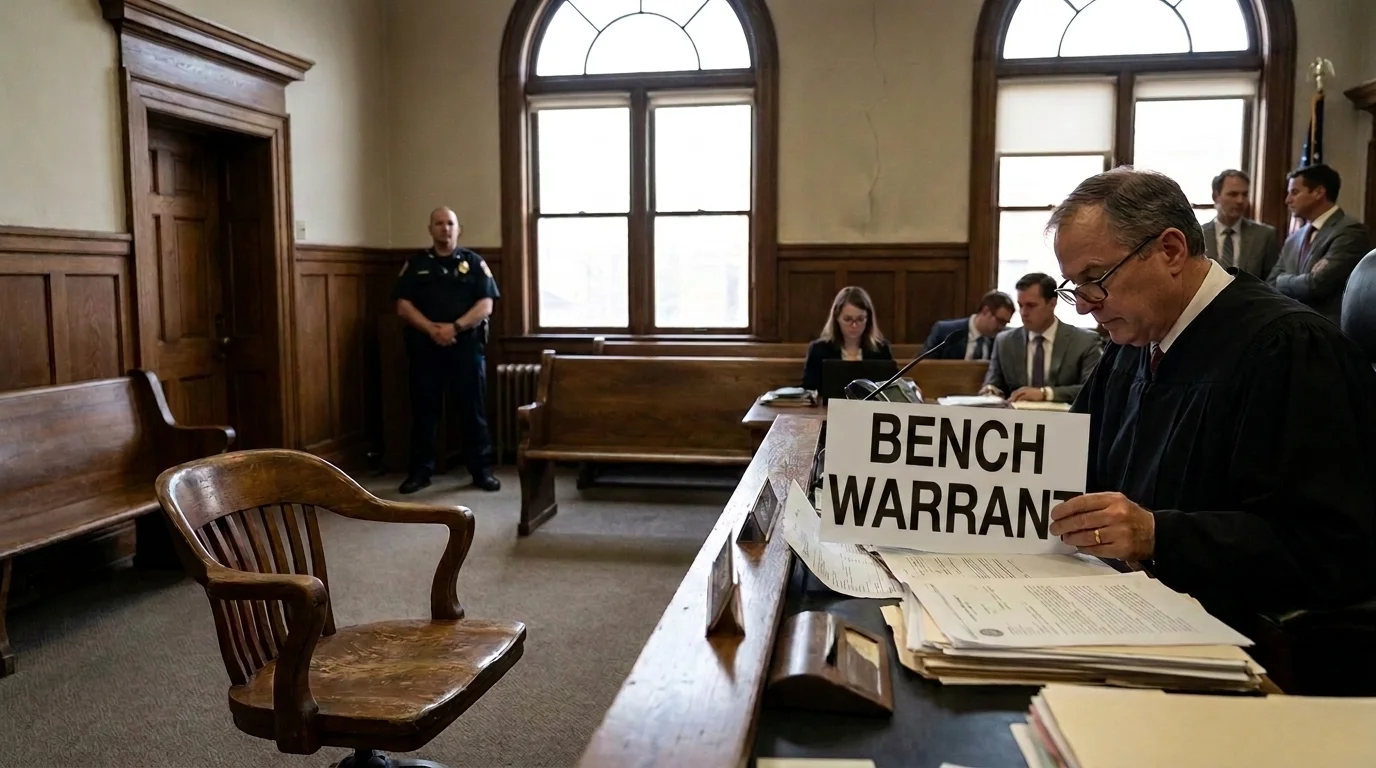
A bench warrant is a court order authorizing law enforcement to arrest someone and bring them before a judge. It commonly follows a missed required court appearance. The exact rules and consequences depend on the state, court, type of case, and reason the person failed to appear.
Short answer: A judge can issue this warrant after someone misses a required court appearance or, in some jurisdictions, after other forms of noncompliance with a court order. It authorizes law enforcement to arrest the person and bring them before the court. The safest response is to verify the warrant and promptly follow the issuing court’s instructions.
| Question | General U.S. answer |
| Who issues it? | A judge or court |
| Common trigger | Missing a required court appearance |
| Can it lead to arrest? | Yes |
| Can bail be affected? | It may be, depending on the case and local rules |
| Does time automatically clear it? | You should never assume that it does |
| Best first step | Verify the status through the issuing court |
Key Takeaways
- A judge usually issues this type of warrant after a person fails to appear as required.
- A valid warrant can authorize an arrest during a later encounter with law enforcement.
- Arrest, release, bail, and hearing procedures vary by jurisdiction.
- Do not assume the problem disappears because months or years have passed.
- Verify the case through an official court source and seek local legal advice when needed.
Why a Bench Warrant Is Issued
The most common reason is failure to appear in court. New York courts define thee order as one issued by a judge when a person does not appear as required. Maryland courts use a similar definition for a criminal defendant who fails to appear.
Circumstances can differ by jurisdiction and case. A court may also take action when someone disobeys an order, violates release conditions, or fails to comply with another judicial requirement.
The terminology matters. Maryland Courts, for example, note that a criminal defendant may face this type of arrest order after missing a court date. A date in a civil or family matter may involve a writ of attachment instead.
That distinction is one reason generic online advice can be misleading. The name of the order and the procedure for resolving it depend on where the case is filed.
Court orders can also remain important long after an initial proceeding ends. Clipaper’s guide to legal matters that may continue after divorce covers examples involving support, custody, and other continuing obligations.
What Happens After the Warrant Becomes Active?
The order authorizes law enforcement to arrest the named person and bring them before the court. New York courts state this directly in their definition.
That does not mean every police department will search for every person with the same level of urgency. Enforcement practices depend on the jurisdiction, the warrant, the underlying case, and local priorities.
Still, avoiding police contact is not a solution. A valid outstanding order can surface during a later encounter with law enforcement. The person may then be taken into custody.
What happens afterward varies. A judge may address the missed appearance, review release conditions, set another hearing, or decide on bail or custody. Maryland court guidance also confirms that failure to appear can result in bail forfeiture in some criminal cases.
If you are already on pretrial release, avoiding another missed appearance is especially important. Clipaper’s court preparation after bail guide recommends confirming the hearing date, location, and time and keeping your case documents organized.
Bench Warrant vs. Arrest Warrant: What Is the Difference?
Both orders can authorize police to arrest a person, but they usually arise at different stages.
| Issue | Court-issued order after nonappearance | Typical arrest warrant |
| Common reason | Missed court appearance or related court issue | Allegation that a person committed an offense |
| Typical setting | An existing court proceeding | An investigation or the beginning of a criminal case |
| Issuing authority | Judge or court | Judge or magistrate after the required legal showing |
| Can police arrest the person? | Yes | Yes |
| Main purpose | Bring the person back before the court | Authorize an arrest based on the alleged offense |
The safest distinction is the reason for issuance. A bench warrant commonly follows a problem involving an existing court proceeding. An arrest warrant typically authorizes the arrest of someone for an alleged offense.
The labels alone do not tell you what will happen after an arrest. Local law, the underlying charge, prior court history, and the judge’s orders can all affect what happens next.
How Long Can an Outstanding Court Warrant Last?

There is no single nationwide expiration rule that applies in every case. The relevant jurisdiction and court govern warrant procedures.
For practical purposes, never assume that waiting will make the order disappear. Check its current status directly with the issuing court or through an official government warrant system, where one is available.
Checking directly with the court is safer than relying on an old letter, an unofficial search website, or a third-party database. Court records can change after a judge recalls or vacates an order.
If you do not know which court issued the warrant, start with the paperwork from your case. A case number, citation, hearing notice, arrest record, or lawyer’s file may help you identify the correct court.
How to Address an Outstanding Warrant Safely
Do not guess at the procedure. A method that works in one county may not be available in another.
Use this sequence:
- Confirm that the warrant exists. Check the issuing court’s official website, clerk’s office, or authorized government database.
- Identify the case. Record the court name, case or docket number, underlying charge, and missed hearing date.
- Ask about the court’s procedure. Find out whether the court requires an appearance, motion, new hearing, or another formal step.
- Consider speaking with a local attorney. This can be especially useful if the case may involve arrest, bail, probation, immigration consequences, or a serious criminal charge.
- Follow the court’s instructions exactly. Keep copies of notices and confirmation of any new appearance date.
New York City Criminal Court, for example, states that its warrants are cleared or vacated through an appearance before a judge. That specific procedure should not be assumed to apply in every state.
If your case remains active afterward, use a calendar reminder and verify future dates. Clipaper’s Law section also collects related articles about court preparation and legal issues.
Three Mistakes That Can Make the Situation Worse
Ignoring the court notice is the first mistake. A missed appearance can delay the underlying case and expose you to an unexpected arrest later.
Assuming a payment automatically clears everything is another mistake. Do not consider the matter resolved until the issuing court confirms the warrant’s status.
The third mistake is paying a caller who claims that an immediate payment will prevent your arrest. Maryland Judiciary has warned about scams in which callers falsely claim that someone faces arrest for failing to appear. Verify unexpected payment demands through official court contact information before sending money.
Take the Next Step Through the Issuing Court
An outstanding warrant is a court matter, so the issuing court is the most reliable place to start. Confirm the case number, current status, and required procedure instead of relying on assumptions.
If you have a lawyer, contact them promptly. If you do not, consider speaking with a local attorney when the consequences are unclear or an arrest is possible.
Most importantly, keep every future court date. Confirm the location and time in advance, save your paperwork, and follow all release conditions exactly.
Frequently Asked Questions
Not necessarily. The legal consequences of failing to appear depend on the jurisdiction, the type of proceeding, the underlying case, and the circumstances. A missed appearance can still result in an arrest order, even when additional criminal liability is not automatic.
Do not assume that it expires automatically. Duration and recall procedures can vary by jurisdiction. The reliable approach is to check the current status with the court that issued it.
Yes. A valid outstanding warrant can authorize an arrest if law enforcement discovers it during a traffic stop or another encounter. What happens next depends on the issuing jurisdiction and the specifics of the case.